
NES Process Feature
Become a champion: Follow the NES bearing qualification process
By J.P. BUTLER
Marketing Coordinator
In a recent advertisement, displayed in distinct white lettering against a black backdrop, the message is clear:
“In bearing testing, like athletics, becoming a champion requires following a process,” maintains Napoleon Engineering Services, the company to whom the ad belongs. “… Become a champion by following the NES qualification process.”
But what, exactly, is the process? What does it entail?
AT NES, there’s a path to premier bearing supplier qualification for two different categories: industrial-grade and aircraft-grade. For the former, which typically applies to original equipment manufacturers (OEMs), that process centers largely on NES’ source qualification inspection program (SQI), bearing modeling and bearing testing. For the latter, which relates more to aerospace companies, it consists primarily of NES’ unparalleled reverse engineering capabilities in support of maintenance repair and overhaul.
The goal of the industrial process is simple: to successfully qualify a new bearing supplier. This can, in many instances, be achieved by passing NES’ renowned SQI, a series of extensive inspection tests. On the aircraft side, the objective is to achieve FAA-certified parts manufacturer approval (PMA).
Both are at the core of Napoleon Engineering’s inspection and testing services.
Both have been refined – and perfected – over the last 25-plus years.
Both are proven offerings, having satisfied hundreds of customers in that timeframe and dozens within the last several years.
Though the SQI might be its forte, NES has long equally prided itself on its reverse engineering proficiency. This has led not only to the drawing for PMA approval, but quite often the task of manufacturing the bearing in that drawing. And that’s hinged primarily on one factor: Its meticulous attention to detail.
Following the process.
“A proper reverse engineering job should provide ALL information for a design engineer to manufacture that bearing,” NES president Chris Napoleon said. “There should be no questions as to what the design or manufacturing intent is. It should possess any vital information needed to make it in the likeness of the original bearing.”
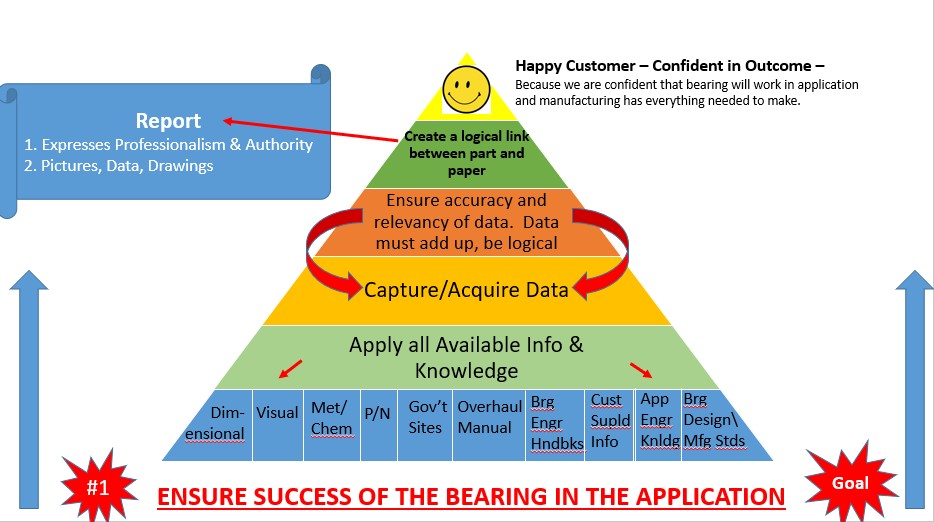
NES ADHERES to a step-by-step pyramid (pictured here) to ensure the success of a bearing in an application. At the foundation are 10 checkpoint items that set the tone for the remainder of the operation.
Napoleon Engineering first establishes a wealth of knowledge based on part number, government site/national stock number searches, overhaul manuals, bearing engineering handbooks, customer-supplied information and its own expansive application engineering and bearing manufacturing knowledge. Next, it enters the lab for the inspection portion – dimensional, visual and metallurgical/chemistry. It then marries those two components to attain a full understanding of a bearing’s design and manufacturing standards.
“Anyone can design something,” Napoleon said. “Those who understand the manufacturing process and the applicable tolerances within that process design the best part. There are a lot of things that allow you to become a champion here. You have to follow this process.”
He added: “You apply all this available knowledge, acquire the data and display the accuracy and relevancy of the data. You send the part out to the lab; they inspect it, we analyze it. We might then take that measurement again or take additional measurements based on what we’ve learned.”
Based on this information, NES can create a logical link between the part and paperwork. From there, it generates a report that’s both professional and authoritative, one that includes pictures, data and drawings. And given that this data is sent for review by an FAA engineer who’s responsible for providing final PMA authorization, it’s critical that it’s both commanding and complete.
And with this, it’s achieved its ultimate goal: A satisfied customer.
“That’s the process,” Napoleon said matter-of-factly. “And when you follow it, you have a good outcome. We’re confident in that outcome.”
NES IS confident enough in its procedure that, in this latest advertising campaign, it described itself as the “champion of bearing qualification.” From where does such a bold proclamation stem? From decades of experience, tremendous growth in both plant and personnel and from homing in on the one component it knows best:
Bearings.
“We have bearing-specific pieces of equipment, and more of it,” Napoleon said. “We manufacture bearings, so we know standards, we know what a manufacturing plant can hold for tolerances and we have bearing specialists. We can bring all of this together. We have the people that can create that logical link.”
It’s one thing, NES’ chief engineer went on, to be a metallurgical lab that takes measurements of all varieties. It’s fine to be a dimensional inspection house that measures “anything and everything.”
NES, however, isn’t those things. The Olean, N.Y.-based company has placed its focus on one area – “All we measure everyday are bearings,” Napoleon pointed out. It has developed volumes of data, over countless such jobs, which help to inform decisions on a product it might be analyzing today. The result: It’s become the expert at bearing qualification services.
And those results have spoken for themselves.
“It’s important to remain humble, to put your head down and work,” Napoleon said. “(But) I’m confident in saying I doubt anyone else in the world, definitely no other company in the world, has done more reverse engineering jobs in support of PMA than us. This is what we do.”